Mission
To Create HOPE and Improve Health Outcomes in Underserved Communities Near and Far.
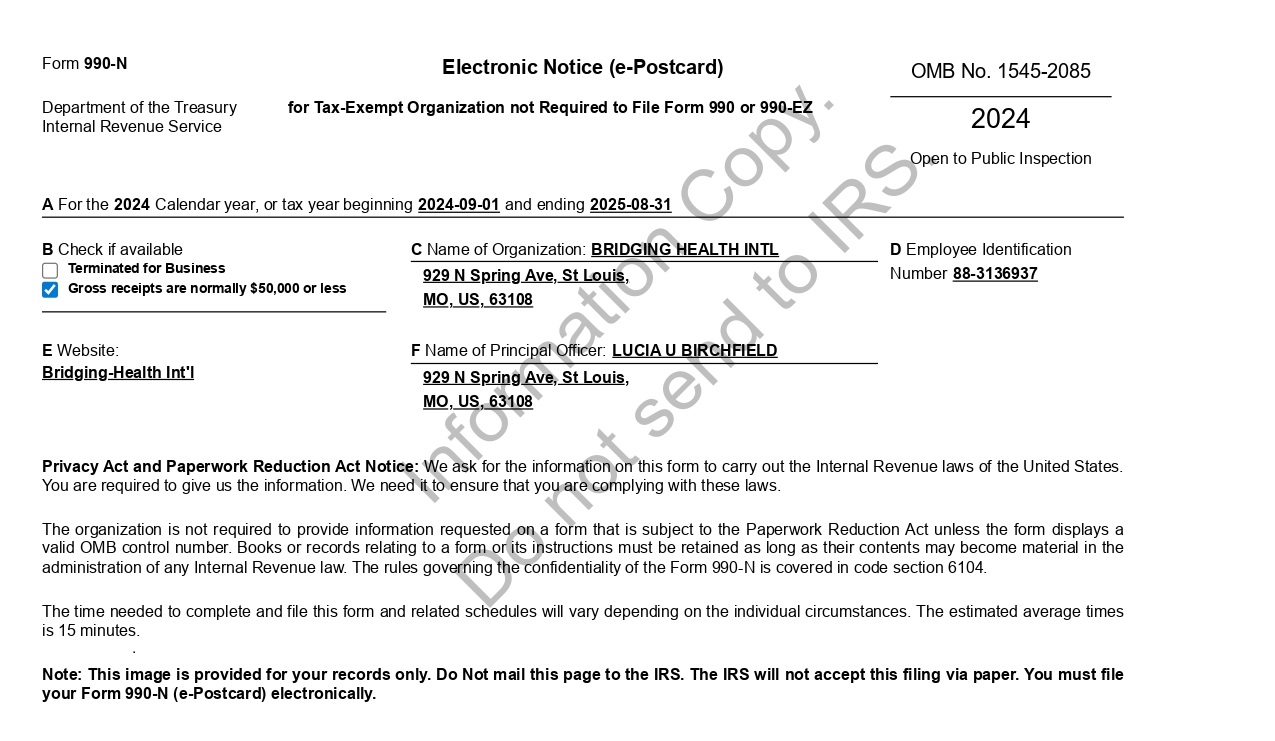
Bridging Health Int’l (BHI) is a registered 501(c)(3) nonprofit organization, tax exempt since August 2022 (EIN: 88 3136937), headquartered in St. Louis, Missouri, USA. BHI holds a subsidiary in Nigeria- Ascending-Health Foundation (AHF), its implementation arm in Nigeria.
We are proud members of the American Public Health Association (APHA), reflecting our commitment to advancing public health through equitable, sustainable, and community-centered initiatives.
As part of our ongoing commitment to transparency and accountability, Bridging Health Int’l is actively progressing through the Charity Navigator evaluation process. We have completed the initial stages of verification and profile setup and continue to upload governance, financial, and impact documentation required for full rating consideration. This process strengthens our credibility and ensures partners and supporters can engage with full confidence in our stewardship and mission.
To Create HOPE and Improve Health Outcomes in Underserved Communities Near and Far.
We envision a world where everyone regardless of geography or socioeconomic status—has access to health, education, and opportunity.
Bridging-Health Int’l. envisions a world where everyone has access to health and opportunity. We are committed to addressing the Social Determinants of Health (SDOH) by implementing programs that promote health and well-being, in alignment with the Sustainable Development Goals (SDG) agenda. According to the CDC, SDOHs are “conditions in the places where people live, learn, work, and play that affect a wide range of health and quality-of-life risks and outcomes” (CDC, 2022).
To promote health equity to underserved and marginalized populations. Our community-based approach ensures that programs are guided by evidence-based research. Our interventions address the principles of the Social Determinants of Health (SDoH).
Bridging-Health Int’l addresses health disparities through the lens of the Social Determinants of Health (SDOH)—the conditions in which people live, learn, work, and play that influence health and quality of life.
Health and education are deeply interconnected. Poor health limits educational attainment, while limited education exacerbates health inequities. For adolescent girls in particular, menstrual health and hygiene remain a critical yet overlooked determinant of health, dignity, school attendance, and long-term socioeconomic outcomes.
Bridging-Health Int’l operates through a global implementation model designed to ensure cultural relevance, accountability, and local ownership.
BHI’s work in Nigeria is implemented through its subsidiary, Ascending Health Foundation (AHF), which serves as our in-country implementation and research arm. AHF leads:
This structure enables locally informed interventions while maintaining strong governance and oversight from the U.S.-based nonprofit entity.
All Bridging-Health Int’l programs are aligned with the United Nations Sustainable Development Goals (SDGs), ensuring our work contributes to globally recognized development priorities.
Key SDGs guiding our work include:
SDG 1: No Poverty: Reducing socioeconomic barriers that limit access to healthcare, education, and basic human needs.
SDG 3: Good Health and Well Being: Strengthening community health systems, promoting disease prevention, and expanding access to essential health services.
SDG 5: Gender Equality: Promoting women’s health, menstrual equity, and inclusive opportunities that uplift girls and women.
SDG 6: Clean Water and Sanitation Supporting hygiene practices and WASH education in rural and resource limited communities.
SDG 10: Reduced Inequalities: Bridging gaps in access to health services for marginalized and underserved populations.
SDG 17: Partnerships for the Goals: Strengthening local and global collaboration—including strategic partnerships with Rotary Clubs, healthcare institutions, academic bodies, and community leaders.
Through targeted interventions, Bridging Health Int’l works to:
Our programs prioritize rural and underserved communities, with a focus on long-term impact rather than short-term aid.
(Impact metrics reflect cumulative program reach across current Period Poverty Reduction Campaign initiatives)
Together with our partners, volunteers, and communities, Bridging Health Int’l works to create hope, restore dignity, and improve health outcomes—near and far.
We are committed to:
Health equity is not a privilege—it is a right. Bridging-Health Int’l exists to help make that right a reality.